

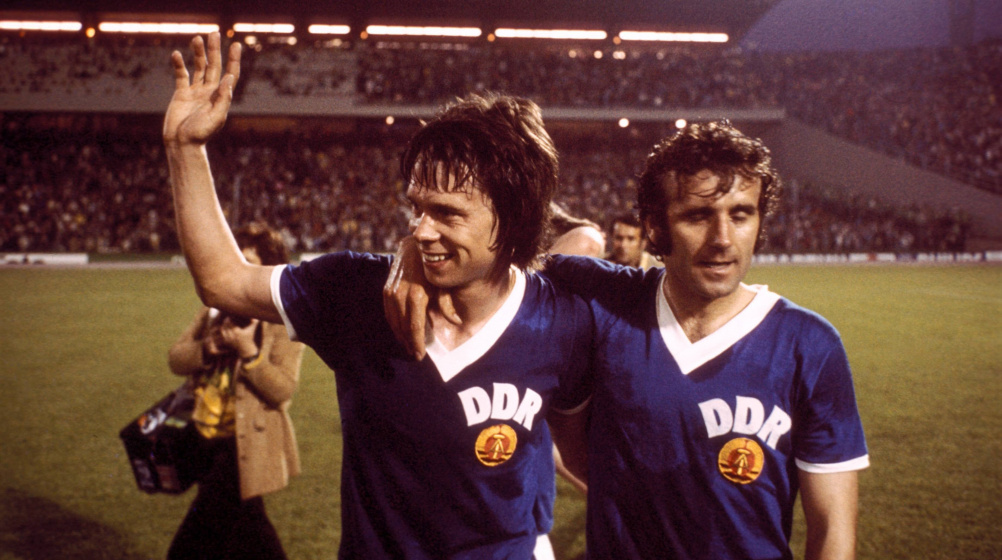
Words by James Bennett | Published 13.06.2026The 1990 World Cup was a symbolic triumph for West Germany. Lothar Matthäus lifted the trophy in Rome just nine months after the fall of the Berlin Wall, in what was recognised at the time as the last World Cup for a divided Germany.
Reunification was completed less than three months later, and the team competed simply as Germany after this, continuing the record, colours and traditions of one of the world’s dominant teams.
Just as capitalism had triumphed over communism in the Cold War, so in football it was West Germany that emerged with the silverware at the end of the years of division.
Except that there was another side to this. The last World Cup where two German teams entered nearly saw both qualify, as East Germany took their fiercely competitive qualifying group down to the last game, just days after the fall of the wall.
Instead, the East Germans, who only ever qualified for one major international tournament, narrowly missed out on creating one of the most bizarre spectacles in the history of the World Cup, of a doomed country in its final months competing for the biggest prize in the sport.
The qualifying campaign had started back in October 1988, but the history of the East German national team runs a lot deeper. The team played its first match in 1952, playing in blue shirts, a contrast to West Germany’s famous white and black kit.
But it wasn’t for over 20 years that they first qualified for the World Cup, ironically finally making it to the tournament held on their neighbours’ soil in 1974.
At this point, it seemed East German football was on the crest of a wave. Their first World Cup qualification came shortly after the team had won the bronze medal in the 1972 Olympics.
In club football, FC Magdeburg, one of the dominant teams in the Oberliga, won the 1973-74 Cup Winners’ Cup just weeks before the World Cup started. Magdeburg contributed four players to the 1974 East Germany squad, with seven coming from Carl Zeiss Jena, and the others split between other domestic clubs including Dynamo Dresden, Lokomotive Leipzig, and Hansa Rostock, who contributed the country’s greatest player, Joachim Streich.
In the draw, East Germany were sensationally paired with West Germany, marking the first time the teams would face each other. Both sides were guaranteed a spot in the second round when they met in Hamburg, but this still marked arguably the most politically charged game in World Cup history.
With 13 minutes to play, Magdeburg midfielder Jürgen Sparwasser evaded three defenders to fire in the only goal of the game, giving East Germany victory in what would prove to be the only game between the two nations.
Despite his iconic goal, Sparwasser later recalled that he received little reward for his part, and defected to West Germany in 1988, one of many so-called ‘tracksuit traitors’ who chose to leave the country.
After topping their first-round group, East Germany progressed into a tough second-round group with Argentina, Brazil and the Netherlands. Defeats to the latter pair and a draw with the departing Argentinians saw them head home.
One quirk of the draw was that West Germany had landed a slightly easier group, beating Yugoslavia, Sweden and Poland to progress to a final with the Dutch that they would go on to win.
As is often the case in major tournaments, the team that lost the early match regained the bragging rights in the end, but it showed a glimpse of East Germany’s potential as a footballing nation.
However, while West Germany continued its astonishing run of success throughout the 1970s and 1980s, it became harder for East Germany to find success. Despite winning the Olympic gold medal in 1976 and silver in 1980, they were narrowly beaten to qualification for 1978 by Austria despite being unbeaten in their group; ironically, Austria would also go on to knock West Germany out of the World Cup in the second group stage.
In qualifying for 1982, they lost out to Poland, and for 1986, they narrowly lost out to France and Bulgaria despite winning their last three matches, including claiming the scalp of the French, one of their most important wins so far. They beat France again at the end of their 1988 European Championship qualifying campaign, but finished their group in second, two points behind the Soviet Union.
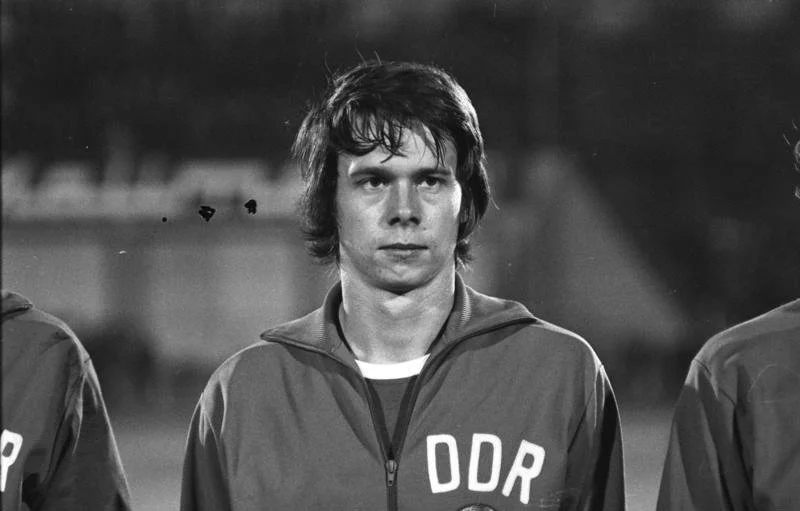
Jürgen Sparwasser on duty for the DDR National Team, 1973.
Photo Credit: Wikimedia Commons
Meanwhile, things were changing at home, and not necessarily for the better. Beyond the social issues of the DDR in the 1980s, the Oberliga was influenced heavily by the Stasi in favour of Berliner FC Dynamo, the favoured team of its head Erich Mielke.
Dynamo won ten league titles in a row between 1979 and 1988 with the help of pliant referees and opponents. Allegations later surfaced that East Germany’s coach for much of the 1980s, Bernd Stange, was a Stasi informant, passing on information about the political inclinations of the national team’s players; other players and coaches would also face similar accusations.
The influence of the state didn’t prevent East German sides competing well in European competition, with Carl Zeiss Jena and Lokomotive Leipzig reaching the final of the Cup Winners’ Cup during the 1980s.
But despite this, the national team lagged behind other teams from behind the Iron Curtain, such as the Soviet Union, Poland, Hungary and Czechoslovakia, who were all regular qualifiers to major tournaments.
This was in contrast to East German dominance in other sports during the 1980s. Marita Koch, Uwe Hohn and Heike Drechsler tore up the record books in track and field, Katarina Witt dominated figure-skating, Kristin Otto won a hatful of gold medals in the pool, and Henry Maske led a stellar generation of East German boxing talent.
But this individual success never translated to football, where East German players never gained the same feared reputation.
1990 World Cup qualifying was a major opportunity to change that, though, with East Germany being handed a draw that seemed to offer a realistic path to Italy. Of the most concern was Valeriy Lobanovskyi’s powerful Soviet Union side, recent runners-up in the 1988 European Championship.
Joining them would be Austria, Turkey and Iceland; on paper, three beatable teams. It would prove to be an exceptionally tight group, and the two qualifying spots wouldn’t be decided until the last round of matches.
By the time East Germany kicked off their campaign in October 1988, two matches had already taken place: Iceland had already drawn at home to the Soviet Union and away in Turkey, taking handy points off two of the East Germans’ main rivals, before heading to the Friedrich-Ludwig-Jahn-Sportpark, the snug Berlin home of BFC Dynamo.
Stange’s side was led by 23-year-old BFC Dynamo forward Andreas Thom, who formed a youthful partnership up front with 22-year-old Dynamo Dresden striker Ulf Kirsten. Thom, who would be crowned East German Footballer of the Year shortly after, proved to be the hero in the first match, scoring twice in a 2-0 win over Iceland to give the team an immediate one-point advantage.
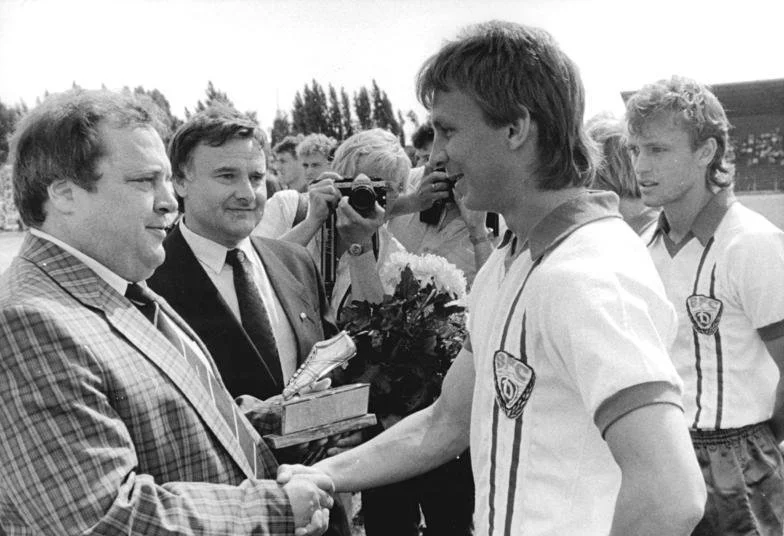
Thom received the East German Footballer of the Year award in 1988.
Photo Credit: Wikimedia Commons
However, the trip to Istanbul brought the first setback. Galatasaray’s goalscorer extraordinaire Tanju Çolak, Europe’s most lethal striker in 1988-89, stole in behind a distracted East German backline to give them a 23rd-minute lead, and midway through the second, he doubled his tally with a spectacular free kick.
Oğuz Çetin strolled into the box six minutes later to add a third to seal what would be a crushing 3-1 defeat. This anaemic display with lax defending would ultimately be the final straw for the DFV, the East German football federation, who opted to move on from Stange’s services after over five years.
New coach Manfred Zapf was a legend for Magdeburg, and a member of the bronze-winning Olympic team from 1972. However, his arrival didn’t spark an improvement. While East Germany won Zapf’s first friendly 4-0 in Egypt in February, results after this were disappointing, culminating in two disastrous performances in their qualifiers in April.
The home match against Turkey in Magdeburg would prove a crucial match in the group. Like most Eastern European teams, East Germany were formidable at home, but their defensive frailties cost them dearly as they endured their only home loss of the campaign.
Tanju once again starred, meeting a Rıdvan Dilmen cross after the East German defence had again lost its shape to give the visitors a surprise early lead, and with two minutes to go, the poacher turned provider by drawing goalkeeper René Müller out of his goal and sliding a pass to Rıdvan to tap into an empty goal. It was a tragicomic ending to a catastrophic day: Müller would never play for East Germany again.
Meanwhile, two weeks later in front of 100,000 people in Kyiv, East Germany couldn’t resist the pressing and speed of Lobanovskyi’s awe-inspiring Soviet Union, who got off to a blistering start by taking the lead within three minutes, and scored another two goals in the first half, the stand-out being a blistering long-range strike from Hennadiy Lytovchenko.
A third defeat in four matches seemed to spell the end of any hopes of qualifying for another four years for the visitors.
However, as in qualifying for 1986, this team showed resilience and steel. The turning point came in May against Austria at the Zentralstadion, the crumbling home of Lokomotive Leipzig that has since been transformed into the modern home of RB Leipzig.
Toni Polster, the perma-permed forward leading a new generation of Austrian talent, gave the visitors an early lead after more sloppy defending less than three minutes in. But with four minutes to go, Kirsten volleyed in a brilliant equaliser, and they escaped with a draw.
It was enough to keep the campaign alive a little longer. However, it wasn’t enough to keep Zapf in his job, as he was dismissed after just three months, in which he had won one of his six games in charge.
He would be replaced by Eduard Geyer, manager of the Dynamo Dresden team that had just ended BFC Dynamo’s run of Oberliga titles. It would signal a shift in the dynamics of the team.
Dynamo Dresden’s star was young midfielder Matthias Sammer. At just 21, the ginger dynamo was marking himself out as the East German take on the foremost West German player of the time, Lothar Matthäus.
Equally excellent in attack and defence, he had started to establish himself as the lynch pin in the side, and East Germany’s last truly great player. Under Geyer, the team would revolve around Sammer’s explosive attacking energy, and he played a key role in the revival of their fortunes towards the end of the campaign.
Geyer’s impact was immediate: in his first game in charge, East Germany won 3-0 in Reykjavík with goals from Sammer, Rainer Ernst and Thomas Doll, eliminating Iceland from contention in the process.
With the Soviet Union and Austria dropping more points to Iceland before drawing with each other, and Turkey losing to Iceland two weeks later, the East Germans were firmly back in the mix.
However, a lot still needed to fall their way, especially as their next visitors, the Soviet Union, were group leaders. They couldn’t realistically catch the Soviets, being four points behind with two games left and with an inferior goal difference, but second-placed Austria were just two points ahead and were due to play Turkey, who were on the same number of points as East Germany. Any two of the four teams had a chance of qualifying.
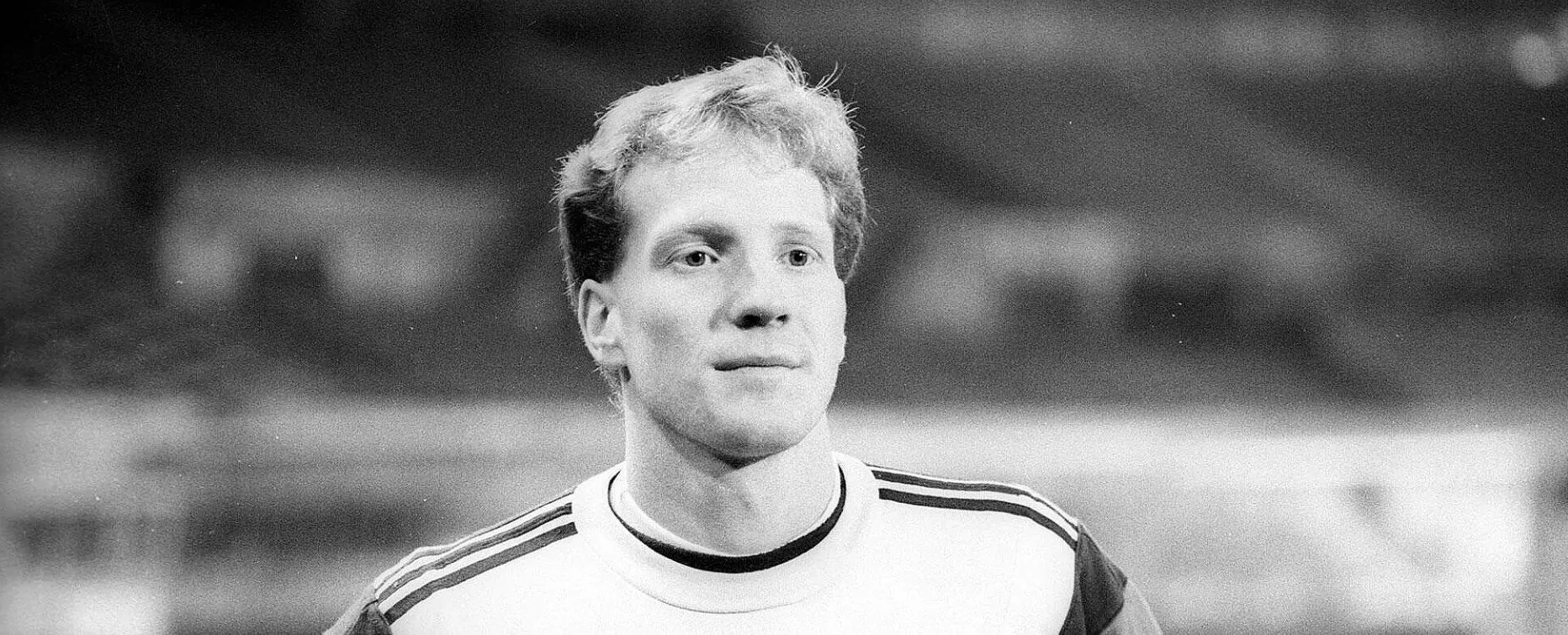
Matthias Sammer as a young man.
Photo Credit: Deutsches Fußballmuseum
The game in Karl-Marx-Stadt remained level until the 74th minute, when Lytovchenko spectacularly volleyed in what looked like the goal that would kill off East German dreams for good.
But again they summoned energy and resilience when they needed it the most. Just seven minutes after conceding, goalkeeper Viktor Chanov flapped at a corner, and Kirsten’s looping header was helped on by Thom at close range.
Two minutes later, with the East Germans hoisting it forward, a poor defensive clearance fell to Sammer on the edge of the box, and he smashed it past the flailing Chanov to give the team a hugely significant win.
This was a remarkable recovery, rising from the dead to beat one of their Eastern Bloc rivals, who were established as one of the best teams in the world, to keep themselves in contention to qualify.
Now all they had to do was finish the job in the final game. That would come against Austria in Vienna on 15 November, who crucially lost 3-0 in Istanbul to leave themselves exposed in the final round of games.
Turkey travelled to Simferopol knowing a win over the Soviets would guarantee them their first World Cup spot since 1954, while East Germany and Austria both needed a win and for the Soviets to hold Turkey to at least a draw.
Amidst all of this, history was unfolding. Defections from East Germany had increased through much 1989 as the border between Hungary and Austria was gradually scaled back and eventually opened, giving people an accessible route from the Eastern Bloc into Western Europe for the first time in recent history.
The autumn saw growing protests in Leipzig and East Berlin, leading to the ousting of East German head of state Erich Honecker after over 18 years in power, and, days later, the opening of the border with Czechoslovakia. Then, on 9 November, just six days before the final qualifiers, the gates that divided Berlin were flung open, and the city’s infamous wall started to be torn down.
East Germany was seemingly a doomed nation state, with reunification now increasingly likely. The Iron Curtain was falling.
The national football team could not escape the political turmoil at home as it headed into its final game of qualifying, with players watching the scenes from Berlin in their camp in Austria. Thus began the stampede: with restrictions lifting, West German Bundesliga clubs quickly and frantically started to scramble to snap up the best Oberliga players.
There’s no question that such intense interest was a distraction for the players, who were suddenly being offered the chance to earn a fortune on the other side of the vanishing border.
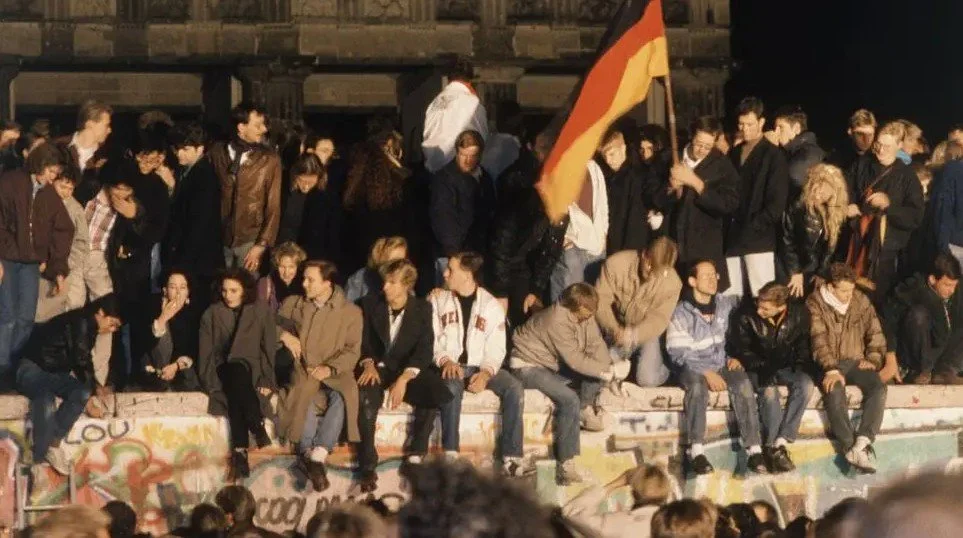
German people from both sides celebrate the fall of the Berlin Wall in 1989.
Photo Credit: German-American Heritage Museum
Nothing typifies this more than a notorious incident from the match itself. Wolfgang Karnath, an under-19s coach for Baver Leverkusen, was able to obtain accreditation as a press photographer, and was tasked by the club’s managing director Reiner Calmund with obtaining the contact details of any East German players who were interested in joining.
Somehow he not only made it onto the East German bench, but was also able to access the team’s hotel and flight back to Berlin after the match. A month later, Leverkusen signed Thom, one of East German football’s most prized assets, making him the first East German to sign for a Bundesliga club. He would soon be joined at the club by Kirsten. Karnath’s intrusion into the camp evidently paid off.
It was perhaps inevitable that in this sort of environment, East Germany’s challenge would wilt. Instead, football history was with Toni Polster: cometh the hour, cometh the perm. The Sevilla striker once again scored after just two minutes, smashing in a long-range drive.
20 minutes later, he added his second via a penalty, and then completed a heroic hat-trick by skilfully meandering through the East German defence after an hour. Rico Steinmann missed a penalty for the visitors, while his captain Ronald Creer was sent off with 15 minutes to go, capping a miserable day in what would prove to be the team’s last ever competitive match.
With Turkey slumping to a late defeat against the Soviet Union, Austria’s first and only win over East Germany was confirmation of a glorious return to the finals after missing the 1986 tournament.
For Polster, it was a personal triumph, as he single-handedly sealed his nation’s place at his first World Cup. Little did he know of the disappointment to come, with defeats to Italy and Czechoslovakia consigning the Austrians to a first-round exit.
But for East Germany, it was another near-miss. They would officially finish fourth in the group, but that doesn’t tell the full story. The team fought back brilliantly after their early setbacks, and after staring elimination in the face, they took the group to the last game. If it had been a month earlier, who knows?
As it was, the end was less than a year away. For qualification for the 1992 European Championship, East Germany were again drawn against their neighbours West Germany, along with Belgium, Wales and minnows Luxembourg.
But in August, six months after the draw was made, German reunification was set for 3 October 1990. East Germany’s opening two matches against Belgium and West Germany were designated as friendlies, with the latter appropriately being pencilled in as the national team’s last match.
Despite 22 players, including Thom and Kirsten, rejecting a call-up – claiming injury or a lack of motivation – East Germany beat Belgium 2-0 on 12 September with Sammer appropriately scoring both goals, giving a tantalising glimpse of what the team could have achieved with him as the driving force in a potential last qualifying campaign.
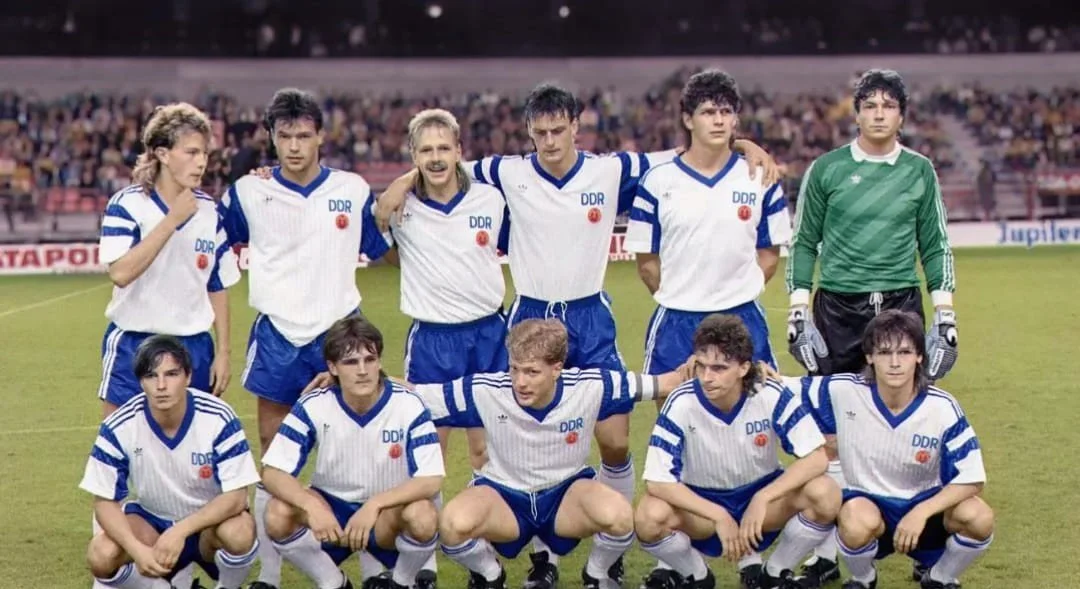
The East Germany squad who contested their final ever match as a nation.
Photo Credit: Football Nations Worldwide
Sadly, what was dubbed the unification game in November was cancelled due to the death of a fan during violent scenes in an Oberliga game in Leipzig, so the friendly against Belgium would go down as the finale.
Sammer would go on to become one of eight players capped for both East Germany and the reunified side. While East German clubs fell away in the German league system, Sammer and Kirsten continued to represent East Germany within the unified team well into the 1990s, and there would also be appearances for Thom, Doll, Dariusz Wosz, Olaf Marschall, Heiko Scholz and Dirk Schuster.
It was Sammer, with his distinctive ginger hair, who would become the defining East German player of the 1990s. It seems very likely that when departing West Germany head coach Franz Beckenbauer told reporters after the 1990 World Cup that a unified Germany team would be unbeatable for many years, he had Sammer in mind.
Though he represented the team in the 1992 Euros and the 1994 World Cup, his defining international tournament was Euro ‘96. Having been converted to a sweeper by Borussia Dortmund manager Ottmar Hitzfeld, he was at his dynamic best in England, driving Germany onto its first international trophy since reunification. He was justly rewarded with the Ballon d’Or at the end of the year, ahead of contemporary superstars Ronaldo and Alan Shearer.
The following year he reached the pinnacle of the club football: winning the Champions League as captain of Borussia Dortmund. Sadly, he suffered a serious knee injury soon after while at the peak of his powers, and he retired in 1998 at the age of 31.
Germany were a lesser force in the two following tournaments without him; an ageing Matthäus came out of international exile to take Sammer’s place at sweeper without ever totally filling the void he had left. Soon after, the sweeper system fell out of fashion altogether. Sammer had been the last great exponent of the art.
The East Germany national team effectively disappeared into history on 15 November 2000, with Dariusz Wosz’s final appearance for the unified side against Denmark. Nearly two decades on, football in the East still lags behind the West, though Red Bull’s investment in RB Leipzig has at least put an East German presence towards the top of the Bundesliga.
But while the blue shirts of the national team are gone, the East has continued to be a part of the unified team of sorts; to see this, you only have to look at the birthplaces of Michael Ballack and Toni Kroos, perhaps the defining German midfielders of their generations. There are only fragments, but East Germany still plays a small part in international football.